A few years ago, in my pre-blog days, I invited my friend, Phil, over for a taste test. The goal was to compare value vs. quality. The contenders: Charles Shaw and Opus One. A showdown of famous cabernet sauvignons (O.K., Opus One is a blend but it’s mostly cab).
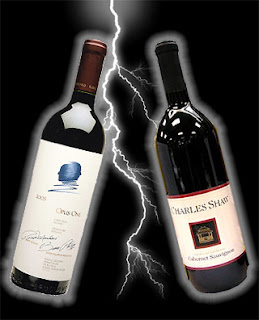
For those of you who have never been to a free art gallery opening or a fundraiser, Charles Shaw is a bargain wine known affectionately as “Two Buck Chuck,” as it sells for $1.99 a bottle in California ($2.99 elsewhere). The Bronco Wine Company purchased the label of Charles Shaw, a failed Napa vintner, and used his name on bottles of blended bulk wines that the company buys from bankrupt wineries. Fred Franzia, the founder of
Bronco Wines, uses this tactic with many of his wines: buy the name of a defunct winery, blend surplus wines nobody wants with his own mass produced juice until the wine is palatable enough to sell for a modest profit. When you multiply that modest profit by the number of cases they sell per year – 20 frickin’ million – and you’re talking about some serious dough-re-mi.
In addition to the purchased labels – Napa Ridge, Rutherford, Montpellier, etc. – the Bronco marketing staff works tirelessly to come up with new, sellable winery names. Almost every bucolic sounding name you see slapped on a bottle in the wine section of your local grocery store is a Bronco wine. Sea Ridge, Crane Lake, Forest Glen, Silver Ridge, Salmon Creek – it reads like the
Ralph Lauren paint catalog. There was a
great article about Bronco in the New Yorker a few weeks ago that delves deeply into all their shenanigans.
On the other end of the spectrum is
Opus One, the pretentiously named chez d’oeuvre of Robert Mondavi, produced in partnership with the Mouton Rothschild folks. It’s the type of wine that revels in how classy it is. Vivaldi’s “Four Seasons” blasts out when you land on their home page just to remind you of their immense sophistication. For over $150 a bottle, their wine better wear white gloves and bring me watercress sandwiches. And then when you multiply that price times the 25,000 cases they produce annually – think of how much Two Buck Chuck you could buy!
If you can’t tell from my snarky tone, neither wine appeals to me that much. Even though my father has no problems with Charles Shaw – “It’s good!” – I’ve always found their wines to be flabby and characterless and sometimes cloying. Yeah, it’s decent for the price, but for a few bucks more you can get something that’s actually good, regardless of cost. With the Opus One, it’s the opposite. It’s good but then you think about how much it costs and think, “Is it $150 good?” Or should I have spent that money to save starving children in the Third World? Then it becomes impossible to enjoy the wine. But for many, that price and the pedigree are shorthand for quality.
I remember when a friend’s wealthy father had a birthday party and offered to let me pick out the first wine. I carefully perused the extensive wine list and picked out a modestly priced but respected Burgundy, thinking of how it might match well with the poached Arctic char. After that, the father flipped to the end of the thick wine list and explained, “I don’t know much about wine. I mostly just go by price.” He then proceeded to buy bottle after bottle of 1988 Chateau Montelena Estate cab that went for over ten times what my choice cost. I was happy to let him order for the rest of the night. Had Opus One been 10 bucks more than the Montelena, we would have drunk that all night.
Why did I own either bottle of wines I apparently despise? The Charles Shaw I bought out of curiosity. The Opus One was a generous gift. When I had both in my hands, it seemed like I had no choice but to have a face-off. Phil brews beer so he has a good palate but knows nothing about wine which made him the perfect candidate. I let him know what the bottles were but poured them for him blindly.
I wasn’t surprised when he insisted the Two Buck Chuck was the Opus One. It’s more fruit forward and what few tannins were there were uncomplicated while the Opus One, while the same vintage as the Shaw (1999), was probably a couple years too young to drink. He described it as being flavorless and harsh. Wine bigwig,
Steven Tanzer, wrote that the ’99 Opus One was, “Rich, sweet and tactile, with complex, tangy flavors of crystallized blackcurrant, caraway seed and smoked meat.” Go figure. Meanwhile, the New York Times wine guy,
Frank Prial, said the ’99 Charles Shaw was, “light, pleasant and easy to drink and has little varietal character…Nondescript would not be too harsh a characterization.”
You can see why many would find the cheaper wine more drinkable. It requires very little thought to process what you’re tasting. It’s wine, it’s inoffensive, drink more. In fact, a Charles Shaw wine won a
California wine tasting. But half an hour or so after being opened, our Charles Shaw’s one dimensionality and acrid finish became more pronounced while the Opus One started to open up beautifully. It was still fairly austere but its layers of berries and violets and minerals became more evident...not to mention that it was rich, sweet and tactile? Plus something about seeds and smoked meat.
So what is the lesson to be learned from this? To gladly accept any Opus One that someone gifts you? Sure. For me it was that there is a threshold for things that are good “for the money.” I was already pretty sure that the Opus One was going to be delicious, just not $150 delicious. But on the low end of things, when do you stop compromising quality for the sake of cost? If your shampoo gives you a rashy scalp and causes your hair to come out in clumps, you can’t justify using it just because there was a 2-for-1 sale at the 99 Cents Store. The Two Buck Chuck wasn’t quite that bad but I want my wine to be more than “nondescript”; I want it to catch my attention and make me feel better about having drunk it. I’ll happily pay two dollars for that privilege but such a wine hasn’t yet passed my lips.
 Traditionally, balsamic vinegar is made from boiled down grape juice. It gets its flavor as it ages in barrels made of various woods: cherry, chestnut, acacia, oak, ash, juniper and mulberry. Over several years, water evaporates so they keep pouring the vinegar into smaller and smaller casks. The finished product ends up tasting concentrated and raisin-y with woody, sometimes resinous, flavors. I have very generous friends who give me some fancy bottle of balsamic vinegar every year for Christmas. Not to sound ungrateful but I hate the stuff.
 Does this look appetizing?
I think it’s so popular because it’s sweet and instantly recognizable. But it’s also incredibly overpowering. A sage-dusted apricot-balsamic glazed chicken breast is just going to taste like chicken dipped in balsamic vinegar. A microgreen salad with an herb raspberry-balsamic dressing is just going to taste like lettuce soaked in balsamic. It’s kind of like Adam Sandler – his movies are dominated by his semi-amusing schtick and there’s not a lot of variation from film to film. But you know what you’re getting so you’re not risking much by buying a ticket. Similarly, there’s not much mystery about what your balsamic dressing’s going to taste like. Me, I like my salads to taste like something more than just cloying vinegar.
Does this look appetizing?
I think it’s so popular because it’s sweet and instantly recognizable. But it’s also incredibly overpowering. A sage-dusted apricot-balsamic glazed chicken breast is just going to taste like chicken dipped in balsamic vinegar. A microgreen salad with an herb raspberry-balsamic dressing is just going to taste like lettuce soaked in balsamic. It’s kind of like Adam Sandler – his movies are dominated by his semi-amusing schtick and there’s not a lot of variation from film to film. But you know what you’re getting so you’re not risking much by buying a ticket. Similarly, there’s not much mystery about what your balsamic dressing’s going to taste like. Me, I like my salads to taste like something more than just cloying vinegar.
 note that it says "gourmet"
So my little trick is to add a tiny splash of seasoned rice vinegar in most of my salad dressings. Seasoned rice vinegar contains added sugar and salt and it has a neutral flavor with mild acidity. So it rounds out the sharpness of a red wine vinegar or lemon juice without adding the sledgehammer flavors of balsamic vinegar. It heightens whatever flavors you have in the salad. People could actually taste the nectarines I put in the salad. Just don’t add too much SRV (if Rachel Ray gets EVO, I'm taking SRV). A little sweetness goes a long way.
note that it says "gourmet"
So my little trick is to add a tiny splash of seasoned rice vinegar in most of my salad dressings. Seasoned rice vinegar contains added sugar and salt and it has a neutral flavor with mild acidity. So it rounds out the sharpness of a red wine vinegar or lemon juice without adding the sledgehammer flavors of balsamic vinegar. It heightens whatever flavors you have in the salad. People could actually taste the nectarines I put in the salad. Just don’t add too much SRV (if Rachel Ray gets EVO, I'm taking SRV). A little sweetness goes a long way.


 One of the standout dishes was the papas Canarias, potatoes in the Canary Islands style. Basically it’s baby fingerlings boiled in salty water with mojo verde. They look unimpressive, shriveled with a thin rime of dried salt, but they taste delicious.So when I had some friends coming over last night, I thought, how hard can it be? I tossed handfuls of salt into a pot of water until it tasted as acrid as seawater and boiled some baby potatoes from the farmer’s market in it for 25 minutes. I drained them and let the taters dry in a warm oven. Meanwhile I grabbed some various herb sprigs from the garden for the mojo verde – mostly Italian parsley, a couple sprigs of cilantro, a couple leaves of basil. I added a garlic clove, a teaspoon of lemon zest, a squeeze of lemon, a half a teaspoon of red pepper flakes with salt and pepper and then blended it with 3/4 a cup of extra virgin olive oil.


 Last night my friends, Drew and Jenna, hosted grilled lobster night with me cooking. Truth be told, while I like lobster, I’m much more of a crab kind of guy. Better flavor, more versatile to cook with, blah, blah, blah. But it was the first hot day of the summer so grilled lobster seemed to be the appropriate
 But then I thought, how big is the difference between five seconds of electrocution and 20 seconds of boiling water? It’s not like the lobster’s going to suffer from post traumatic stress disorder; either way it’s dead. And there’s even
 For three days, we suffered in ways that – well if you need a description, just read the side of a nonfat Pringles can from the ‘90s.


